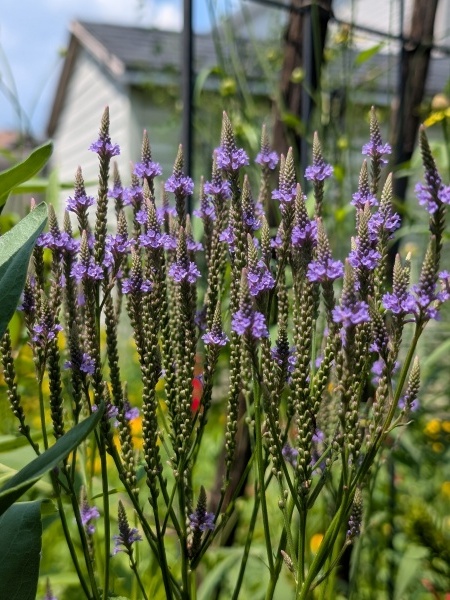
Source: Donna Bos

Verbena hastata
Blue Vervain
Verveine hastée
Synonyms
American blue vervain
simpler's-joy
swamp vervain
verveine scabre
No seeds available for this plant.
We currently accept seeds for this plant
Bloom Colour: Blue
Bloom Period: Jul - Sep
Max Height: 5.0 feet
Max Width: 2.0 feet (spreads by rhizome)
Light Condition:
 More than 6 hours of direct sun a day
 More than 2 or 3 hours but less than 6 hours of direct sun a day
Soil conditions:
More than 2 or 3 hours but less than 6 hours of direct sun a day
Soil conditions:
 Tolerates medium soil condition
More than 6 hours of direct sun a day
More than 2 or 3 hours but less than 6 hours of direct sun a day
Tolerates medium soil condition
Lifespan:
Perennial
plants that will that come back year after year
Gardener Experience:
 Easy to germinate
 Self-seeding
Easy to germinate
Self-seeding
Landscape Uses:
 Suitable for wetland garden
 Suitable for rain gardens
 Suitable for shoreline rehabilitation
 Tolerates boulevard garden conditions
Suitable for wetland garden
Suitable for rain gardens
Suitable for shoreline rehabilitation
Tolerates boulevard garden conditions
Ecological Benefits:
 Supports pollinators
 Butterfly host
Supports pollinators
Butterfly host
Tolerates:
 Tolerates limestone conditions
 Tolerates transplantation
Tolerates limestone conditions
Tolerates transplantation
Special Features and Considerations:
 This plant causes skin rashes
This plant causes skin rashes
Plant Location
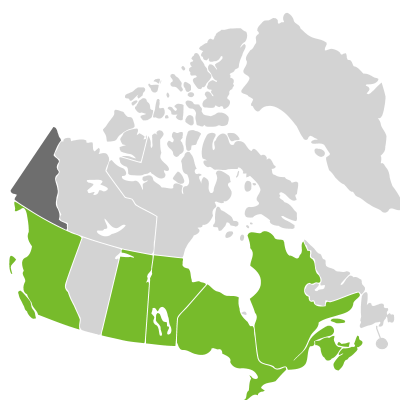
Native to Ottawa region: Yes
Distribution according to VASCAN
Ephemeral
Native
Introduced
Excluded
Extirpated
Doubtful
Absent
 Canadensis

Thrives in Ecozones
- Atlantic Maritime
- Boreal Plains
- Montane Cordillera
- Prairies
- Boreal Shield
- Mixed Wood Plains
Ecological Benefits
Butterflies Supported by Verbena hastata
- Crambodes talidiformis (Verbena)
- Endothenia hebesana (Verbena Bud)
Specialized Bees Supported by Verbena hastata
No bee data available for this plant.
Plants that grow in similar conditions, that bloom at the same time.
Complementary Plants
- Agastache nepetoides
Yellow Giant Hyssop
Agastache faux-népéta - Eupatorium perfoliatum
Common Boneset
Eupatoire perfoliée - Eutrochium maculatum
Spotted Joe Pye Weed
Eupatoire maculée - Lilium canadense
Canada Lily
Lis du Canada - Scirpus atrovirens
Dark-green Bulrush
Scirpe noirâtre
Substitute For Non-Native Plants
- Sorbaria sorbifolia (False spirea)
- Aruncus Dioicus (Goat's Beard)
- Lamium (Dead nettle)
- Perovskia Atriplicifolia (Russian Sage)
- Lupinus (Non-Native Lupins)
- Ajuga reptans (Bugleweed)
- Buddleia (Butterfly Bush)
- Delphinium (Delphinium)
- Salvia (Non-Native Sage)
- Lavandula) (Lavender)
- Hesperis matronalis (Dame Rocket)
- Liatris (Blazing Star Cultivar)
Sowing Information
Download Seed Envelope Labels (PDF)
- Sowing depth: Surface sow
- Sow by March
- Stratification duration: 30 days
- Self-seeding
Harvesting and Seed Sharing
- Harvest start month: September
- Harvesting indicator:
- Pods are brown, seeds are dark, and crisp, and little stem connecting the pod to the main stem is brown (not green)
- Harvesting:
- Shake seed head in paper bag
- Seed viability test:
- No test needed before donating
- Packaging measure: 1 rounded 1/32 teaspoon
- Seed storage:
- Air dry in paper bag or open container, for a few days until crisp, shaking seeds to move them once in a while to prevent molding
- Cultivar: No, you can donate without knowing the source as there are only straight species
- No harvesting video available at this time.
Toxicity Notes
Inadequate information on toxicity found.