Source: OWSL

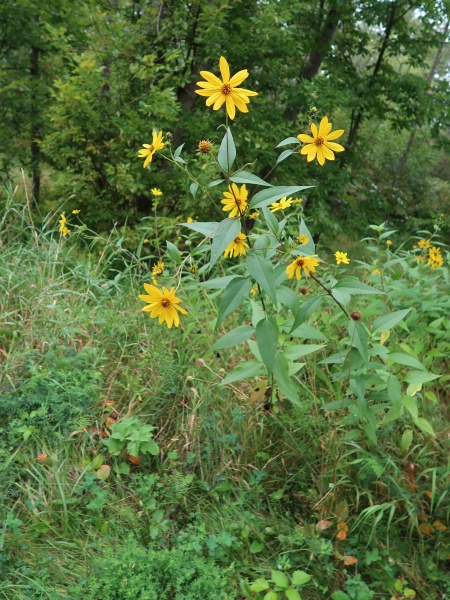
Helianthus tuberosus
Jerusalem Artichoke
Topinambour
Synonyms
hélianthe tubéreux
No seeds available for this plant.
We currently accept seeds for this plant
Bloom Colour: Yellow
Bloom Period: Aug - Sep
Max Height: 6.0 feet
Max Width: 2.0 feet (spreads by rhizome)
Light Condition:
 More than 6 hours of direct sun a day
 More than 2 or 3 hours but less than 6 hours of direct sun a day
Soil conditions:
More than 2 or 3 hours but less than 6 hours of direct sun a day
Soil conditions:
 Tolerates dry soil condition
 Tolerates medium soil condition
More than 6 hours of direct sun a day
More than 2 or 3 hours but less than 6 hours of direct sun a day
Tolerates dry soil condition
Tolerates medium soil condition
Lifespan:
Perennial
plants that will that come back year after year
Gardener Experience:
 Self-seeding
Self-seeding
Landscape Uses:
 Suitable for container garden
Suitable for container garden
Ecological Benefits:
 Supports pollinators
 Bee host
Supports pollinators
Bee host
Tolerates:
 Tolerates limestone conditions
 Tolerates juglone conditions
Tolerates limestone conditions
Tolerates juglone conditions
Special Features and Considerations:
Plant Location
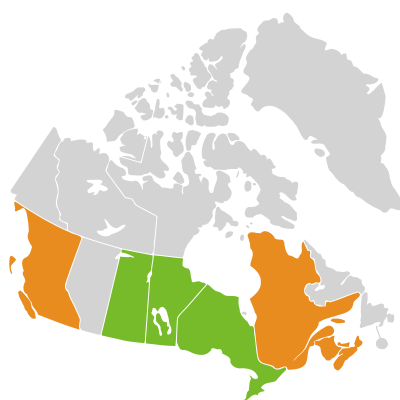
Distribution according to VASCAN
Ephemeral
Native
Introduced
Excluded
Extirpated
Doubtful
Absent
 Canadensis

Thrives in Ecozones
- Atlantic Maritime
- Boreal Plains
- Boreal Shield
- Mixed Wood Plains
Ecological Benefits
Butterflies Supported by Helianthus tuberosus
- Euplexia benesimilis (American Angle Shades)
- Phragmatobia fuliginosa (Ruby Tiger)
Specialized Bees Supported by Helianthus tuberosus
- Andrena aliciae
- Andrena chromotricha
- Andrena helianthi
- Complexe Colletes americanus
- Dianthidium simile
- Megachile inimica
- Megachile pugnata
- Melissodes agilis
- Melissodes denticulatus
- Melissodes illatus
- Melissodes trinodis
- Perdita pallidipennis
Plants that grow in similar conditions, that bloom at the same time.
Complementary Plants
- No complementary plants found.
Substitute For Non-Native Plants
- Leucanthemum (Shasta Daisy)
- Gerbera (Gerbera Daisy)
- Helianthus).1 (Non-Native Sunflower)
- NA (Non-Native False Sunflower)
Sowing Information
Download Seed Envelope Labels (PDF)
- Sowing depth: Sow just below surface
- Sow anytime
- Stratification duration: 0 days
- Self-seeding
Harvesting and Seed Sharing
- Harvest start month: November
- Harvesting indicator:
- Seeds are dark and dry, and easily fall off when you gently pull them off
- Harvesting:
- Shake seed head in paper bag
- Seed viability test:
- No test needed before donating
- Packaging measure: 1 rounded 1/4 teaspoon
- Seed storage:
- Air dry in paper bag or open container, for a few days until crisp, shaking seeds to move them once in a while to prevent molding
- Cultivar: Yes, do not donate unless you know source, and there are no known cultivars in your garden or at proximity
- Remove non-seed material
- No harvesting video available at this time.
Toxicity Notes
Inadequate information on toxicity found.