 Known to be toxic - Toxic to mammals if ingested.
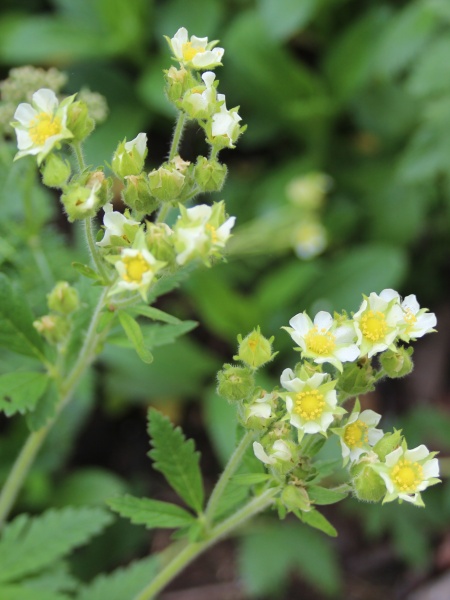
Source: Sundaura Alford-Purvis

Drymocallis arguta
Tall Wood Beauty
Potentille âcre
Synonyms
tall cinquefoil
tall drymocallis
white cinquefoil
No seeds available for this plant.
We currently accept seeds for this plant
Bloom Colour: White
Bloom Period: Jun - Sep
Max Height: 2.0 feet
Max Width: 1.5 feet (spreads by rhizome)
Light Condition:
 More than 6 hours of direct sun a day
 More than 2 or 3 hours but less than 6 hours of direct sun a day
Soil conditions:
More than 2 or 3 hours but less than 6 hours of direct sun a day
Soil conditions:
 Tolerates dry soil condition
 Tolerates medium soil condition
More than 6 hours of direct sun a day
More than 2 or 3 hours but less than 6 hours of direct sun a day
Tolerates dry soil condition
Tolerates medium soil condition
Lifespan:
Perennial
plants that will that come back year after year
Gardener Experience:
 Suitable for beginner gardeners
 Does not spread uncontrollably
 Easy to germinate
 Self-seeding
Suitable for beginner gardeners
Does not spread uncontrollably
Easy to germinate
Self-seeding
Landscape Uses:
 Suitable for rock gardens
 Suitable for Right of Way gardens
 Suitable for school gardens
 Tolerates boulevard garden conditions
Suitable for rock gardens
Suitable for Right of Way gardens
Suitable for school gardens
Tolerates boulevard garden conditions
Ecological Benefits:
No ecological benefits information available.
Tolerates:
 Deer resistant
 Rabbit resistant
 Tolerates foot traffic around the plant
 Tolerates transplantation
Deer resistant
Rabbit resistant
Tolerates foot traffic around the plant
Tolerates transplantation
Special Features and Considerations:
Plant Location
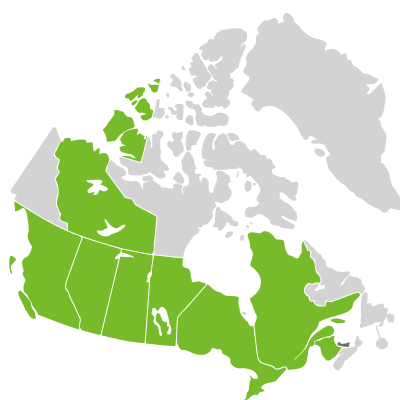
Distribution according to VASCAN
Ephemeral
Native
Introduced
Excluded
Extirpated
Doubtful
Absent
 Canadensis

Thrives in Ecozones
- Taiga Plains
- Taiga Shield
- Boreal Plains
Ecological Benefits
Butterflies Supported by Drymocallis arguta
No butterfly data available for this plant.
Specialized Bees Supported by Drymocallis arguta
No bee data available for this plant.
Plants that grow in similar conditions, that bloom at the same time.
Complementary Plants
- Allium stellatum
Autumn Onion
Ail étoilé - Capnoides sempervirens
Pink Corydalis
Corydale toujours verte - Eragrostis spectabilis
Purple Lovegrass
Éragrostide brillante - Liatris cylindracea
Slender Blazing Star
Liatris cylindrique - Monarda punctata
Spotted Beebalm
Monarde ponctuée
Substitute For Non-Native Plants
- Potentilla (Non-Native Potentilla)
Sowing Information
Download Seed Envelope Labels (PDF)
- Sowing depth: Surface sow
- Sow by February
- Stratification duration: 60 days
- Self-seeding
- Notes: Keep moist and cool until sowing.
Harvesting and Seed Sharing
- Harvest start month: August
- Harvesting indicator:
- Pods are brown and slightly open
- Harvesting:
- Cut stem (including pods), let air dry in paper bag, then shake seeds off after a few days
- Seed viability test:
- No test needed before donating
- Packaging measure: 1 rounded 1/8 teaspoon
- Seed storage:
- Air dry in paper bag or open container, for a few days until crisp, shaking seeds to move them once in a while to prevent molding
- Cultivar: No, you can donate without knowing the source as there are only straight species
- No harvesting video available at this time.
Toxicity Notes
Toxic to mammals if ingested.